
Beyond the Fry

Beyond the Fry – Unlocking Your Air Fryer’s Full Potential
Roasting, baking, and dehydrating in the countertop convection oven.
So you bought an air fryer, used it for frozen fries a few times, and now it’s sitting on your counter collecting dust. Sound familiar? You’re not alone! Many people don’t realize that their air fryer is actually a small but powerful convection oven that can do so much more than crisp up frozen foods.
After 28 years in professional kitchens, I can tell you that understanding your tools makes all the difference. Let me show you how to turn that one-trick appliance into your kitchen workhorse.
The Science of Convection: Why It Cooks Faster and Drier
Here’s what’s really happening inside your air fryer: A fan sits near a heating element and rapidly circulates hot air around your food. According to Kevin Keener, an engineer at the University of Guelph who studies thermal food processing methods, this moving air transfers heat to your food much more efficiently than still air in a regular oven.
Think of it like this: when you blow on hot soup to cool it down, you’re using the same principle but in reverse. The moving air transfers heat faster.
The heating elements in air fryers are typically located on top, with a large fan positioned directly below them. This top-down cooking method concentrates heat more effectively than traditional ovens, which have heating elements on both top and bottom.
The result? Food cooks faster because the rapid air circulation dehydrates the surface quickly, which is the key to achieving crispiness. This is why your air fryer can make things crispy without drowning them in oil.
Reheating Mastery: Why the Microwave is Obsolete for Pizza and Leftovers
Stop using your microwave for leftover pizza right now. Seriously. Your air fryer transforms leftovers in ways that will amaze you.
For Pizza: Set your air fryer to 350°F and reheat thin crust pizza for 3-4 minutes. For thick crust or deep-dish pizza, lower the temperature to 300-325°F and heat for 5-7 minutes.
The Secret: Always arrange slices in a single layer with space between them so air can circulate. Don’t overlap slices this blocks airflow and prevents proper crisping.
Pro tip: If you have time, preheat your air fryer for 2-3 minutes before adding the pizza. This helps achieve maximum crispiness on the crust while keeping the cheese perfectly melted.
The microwave heats food from the inside out with electromagnetic waves, which creates steam and makes things soggy. The air fryer removes moisture from the food’s surface while heating it evenly, recreating the original cooking environment that made your food crispy in the first place.
Whole Chicken: How to Get Rotisserie Results in a Basket
Yes, you can cook a whole chicken in your air fryer! The key is choosing the right size and preparing it properly.
Look for a chicken that weighs 3-4 pounds that will fit in most standard air fryers. Pat it completely dry (this is important for crispy skin), season it inside and out, and place it breast-side down in the basket for the first half of cooking, then flip it breast-side up.
The circulating hot air crisps the skin all around while keeping the meat juicy inside. It’s like having a mini rotisserie oven right on your counter.
Baking: Small-Batch Cookies and Lava Cakes
Your air fryer is perfect for baking small batches when you don’t want to heat up your full-size oven.
Research shows that air fryers can bake high-quality cakes with moist interiors while using lower temperatures and shorter baking times compared to traditional ovens.
For cookies and cakes, use oven-safe pans that fit inside your air fryer basket. Parchment paper or silicone baking cups work great for individual desserts like lava cakes or muffins.
The small space and efficient heat circulation mean you can have fresh-baked treats in about half the time it would take in your regular oven.
Dehydrating: Making Apple Chips and Beef Jerky
Many people don’t know their air fryer can dehydrate food! This is one of its most useful but overlooked functions.
For Apple Chips: Slice apples thinly (about 1/8 inch thick). Set your air fryer to 135-150°F and dehydrate for 6-8 hours, checking occasionally and turning halfway through. The apples should be dry but still slightly pliable when done.
For Beef Jerky: Use lean cuts like top round or eye of round. Slice the beef into 1/4-inch strips, marinate for at least 4 hours (overnight is better), then pat dry. Cook at 160-180°F for 2-3 hours.
Critical Safety Note: For safety, beef jerky must reach an internal temperature of 160°F to kill harmful bacteria. Always use a meat thermometer to verify this.
The secret to successful dehydration is spacing. Leave space between each piece so air can circulate completely around it. Without proper spacing, you’ll end up with partially dehydrated food.
The Vegetable “Char”: Getting Grill-Like Results on Broccoli
Want that delicious charred flavor on your vegetables without firing up the grill? Your air fryer delivers.
Cut vegetables into uniform pieces, toss them lightly with oil, and spread them in a single layer. The intense, concentrated heat from the top creates beautiful caramelization and char marks that you simply can’t get in a regular oven.
Broccoli, Brussels sprouts, and cauliflower work especially well. The florets get crispy on the edges while staying tender inside. It’s the perfect side dish in about 10-12 minutes.
Hard “Boiled” Eggs: The Waterless Method
This one sounds strange, but it works perfectly. You can “hard boil” eggs in your air fryer without any water.
Place eggs directly in the basket (no need for any special equipment). Set the temperature to 270°F and cook for 15-17 minutes, depending on how firm you want the yolk. Then transfer immediately to an ice bath to stop the cooking.
The eggs peel incredibly easily because the hot air creates a tiny gap between the shell and the white. It’s like magic!
Safety & Liners: When to Use Parchment vs. Silicone Mats
Using liners makes cleanup easier, but you need to use them correctly for safety.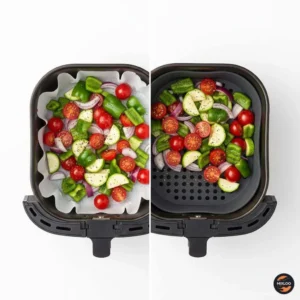
Parchment Paper: Most parchment paper can handle temperatures up to 420-450°F. However, never preheat your air fryer with an empty parchment liner inside the lightweight paper can fly up and touch the heating element, creating a fire hazard.
Always preheat the air fryer first, then add the parchment liner and immediately place food on top to weigh it down.
Silicone Liners: Silicone liners are safer for high-temperature cooking, handling up to 450°F. They’re reusable, dishwasher-safe, and won’t fly around inside the air fryer.
Important: Use perforated liners (ones with holes) to allow hot air to circulate properly. Solid liners without holes can block airflow and prevent food from crisping properly.
Never use wax paper in your air fryer. It looks similar to parchment paper but has a much lower heat tolerance and can catch fire.
Conversion Math: How to Convert Oven Recipes to Air Fryer Specs
This is the game-changer that opens up your entire recipe collection to air fryer cooking.
The Formula: Reduce the oven temperature by 25°F and reduce the cooking time by 20%.
Example:
- Oven recipe says: 400°F for 20 minutes
- Air fryer setting: 375°F for 16 minutes
This works because air fryers cook food faster due to their smaller size and more efficient hot air circulation.
Important tip: The first time you try a converted recipe, check your food a few minutes early. Different air fryer models can vary in how they cook, with some fan speeds being 30% faster than others. Once you know how your specific model performs, you’ll be able to adjust perfectly every time.
Cleaning Hacks: Keeping the Heating Element Grease-Free
A clean air fryer cooks better and lasts longer. Here’s how to maintain it properly:
After Every Use:
- Remove the basket and tray immediately while still warm (not hot)
- Wash with warm soapy water or place in the dishwasher if the parts are dishwasher-safe
- Wipe out the main chamber with a damp cloth
Weekly (if you use it often):
- Check the heating element on top for grease buildup
- Wipe it gently with a damp cloth when the unit is completely cool and unplugged
- Turn the unit upside down to check the bottom vents for crumbs
Deep Clean Monthly:
- Use a soft brush or old toothbrush to clean around the heating element
- Soak removable parts in warm soapy water for 10-15 minutes before scrubbing
- Check the door seal for food particles
The key is consistency. A quick wipe after each use prevents the baked-on grease that requires serious scrubbing later.
Your Air Fryer Journey Starts Now
Your air fryer isn’t just a frozen fry machine, it’s a versatile cooking tool that can roast, bake, reheat, dehydrate, and so much more. The science is simple: rapidly circulating hot air cooks food faster and more efficiently than traditional methods.
Start with one new technique this week. Maybe reheat your pizza the right way, or try making apple chips. Once you see the results, you’ll wonder why you waited so long to explore what this little appliance can really do.
Remember: good cooking comes from understanding your tools and using them confidently. Now you have the knowledge to make something delicious!
All information in this article is based on research from food science experts, manufacturer guidelines, and tested cooking methods to ensure accuracy and safety.
Watch the video: Beyond the Fry


